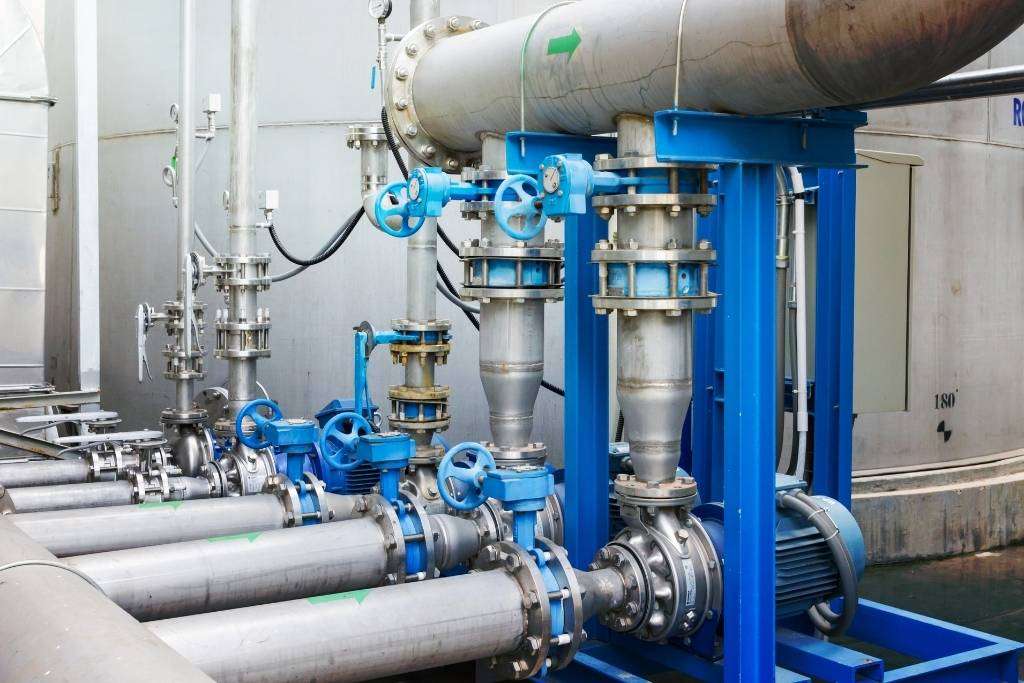
Industrial pumps move potable water, service water, drainage, and sewage across the UAE’s built environment. Accurate hydraulics—flow, total head, NPSH, efficiency, and control—determine uptime and lifecycle cost. This guide by Piranha Ecotech industrial pump specialists explains pump working principles, selection math, NPSH & BEP, impellers, materials, VFD strategies, installation, commissioning, and reliability.
For a complete overview of pump solutions used in UAE infrastructure, explore our main industrial pumps category.
Table of Contents
- Pump Families & Working Principles
- Selection Math: Duty Point, Curves & System Behavior
- NPSH & Cavitation Avoidance
- Impellers, Hydraulics & Efficiency
- Materials, Seals & Construction
- Motors, VFDs & Affinity Laws
- Installation, Commissioning & Reliability
- FAQs
1) Pump Families & Working Principles
Most UAE facility applications are served by rotodynamic (centrifugal) pumps and specialized submersible pumps for drainage and sewage applications.
1.1 Centrifugal Pumps
Principle: The impeller imparts velocity to the liquid and converts it into pressure head.
- End-suction pumps used for water transfer and HVAC circulation.
- Horizontal split-case pumps for high-flow applications.
- Multistage centrifugal pumps for higher head pressure requirements.
1.2 Inline Circulating Pumps
Inline pumps simplify piping installation and are widely used in HVAC and water circulation systems across UAE buildings.
1.3 Booster Pump Systems
Booster pumps maintain stable pressure in tall buildings and large facilities. Variable-frequency drives regulate pump speed to maintain constant discharge pressure.
1.4 Drainage Pumps
Drainage pumps are typically submersible pumps designed to remove stormwater or groundwater from basements and construction sites.
1.5 Submersible Pumps
Submersible pumps operate underwater and are commonly used in wells, tanks, and sump systems.
1.6 Sewage Pumps
These pumps handle wastewater containing solids and are used in sewage lift stations and wastewater treatment plants.
1.7 Fire-Fighting Pumps
Fire pump systems ensure adequate water pressure for fire protection systems and are installed according to civil-defense regulations.
2) Selection Math: Duty Point, Curves & System Behavior
Pump selection begins with the **duty point**, defined by flow rate (Q) and total head (H). Engineers must evaluate system curves, friction losses, and pump curves to ensure reliable operation near the **best efficiency point (BEP)**.
3) NPSH & Cavitation Avoidance
Net Positive Suction Head (NPSH) is critical for preventing cavitation. Cavitation occurs when vapor bubbles form in low-pressure zones and collapse violently, damaging impellers.
4) Impellers, Hydraulics & Efficiency
Impeller design influences efficiency and solids-handling capability.
- Closed impellers for clean water applications
- Semi-open impellers for light solids
- Vortex impellers for sewage pumping
- Grinder pumps for macerating solids
5) Materials, Seals & Construction
Pump material selection depends on water chemistry, temperature, and corrosion risk.
- Cast iron for general applications
- Stainless steel for potable water systems
- Bronze components for marine or hot water duties
- Duplex stainless steel for corrosive environments
6) Motors, VFDs & Affinity Laws
Variable frequency drives improve efficiency and allow pumps to operate at variable speed.
- Flow ∝ Speed
- Head ∝ Speed²
- Power ∝ Speed³
Using VFDs with high-efficiency motors can significantly reduce energy consumption in pump systems.
7) Installation, Commissioning & Reliability
Proper installation practices are essential for long-term reliability.
- Maintain straight suction piping runs
- Use eccentric reducers to prevent air pockets
- Ensure correct pump alignment
- Install non-return valves and strainers
FAQs (Pump-Only)
How close should a pump operate to BEP?
Ideally within 10–15% of the best efficiency point to minimize vibration and mechanical stress.
What is the recommended NPSH margin?
A typical margin is 0.5–1 meter above NPSH required for clean water applications.
Engineering Tools for System Design
Engineers can use our calculation tools to analyze airflow and HVAC system parameters used in pump-integrated systems:
Conclusion
Reliable pumping systems require proper engineering design, material selection, and installation practices. Piranha Ecotech provides engineered pump solutions for commercial, industrial, and infrastructure projects across the UAE.
For expert pump selection and technical consultation, contact our engineering team today.